£795.00
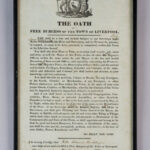
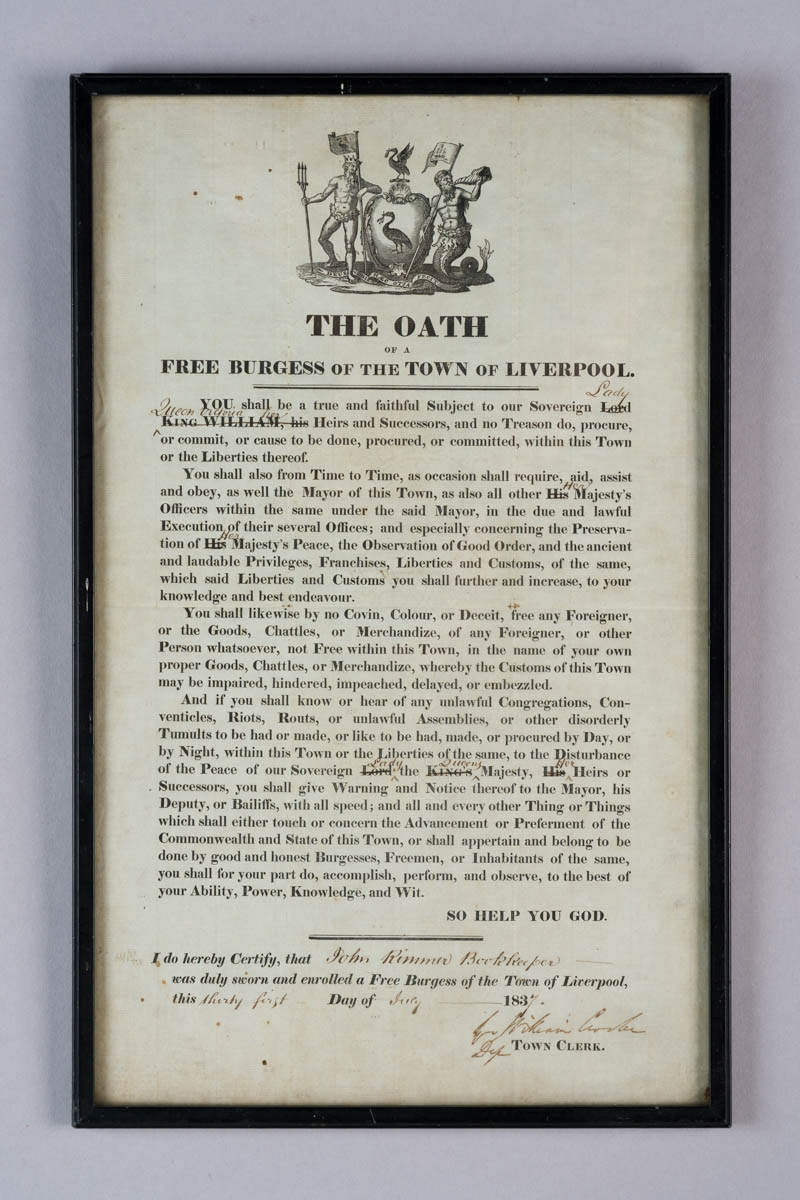
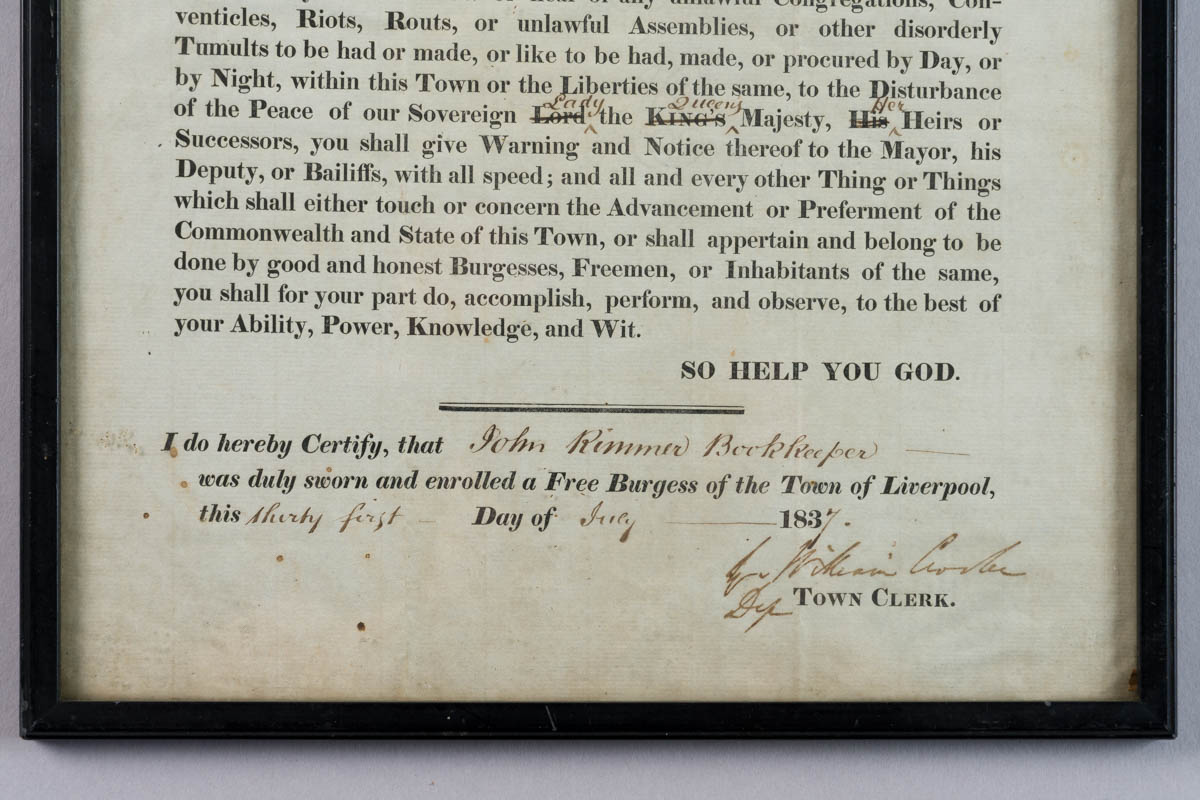
An original Liverpool Free Burgess oath of 1837, printed with the arms of Liverpool and completed in manuscript for John Rimmo [Rimmon], Bookkeeper, recording his admission as a Free Burgess of the town.
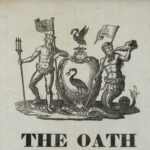
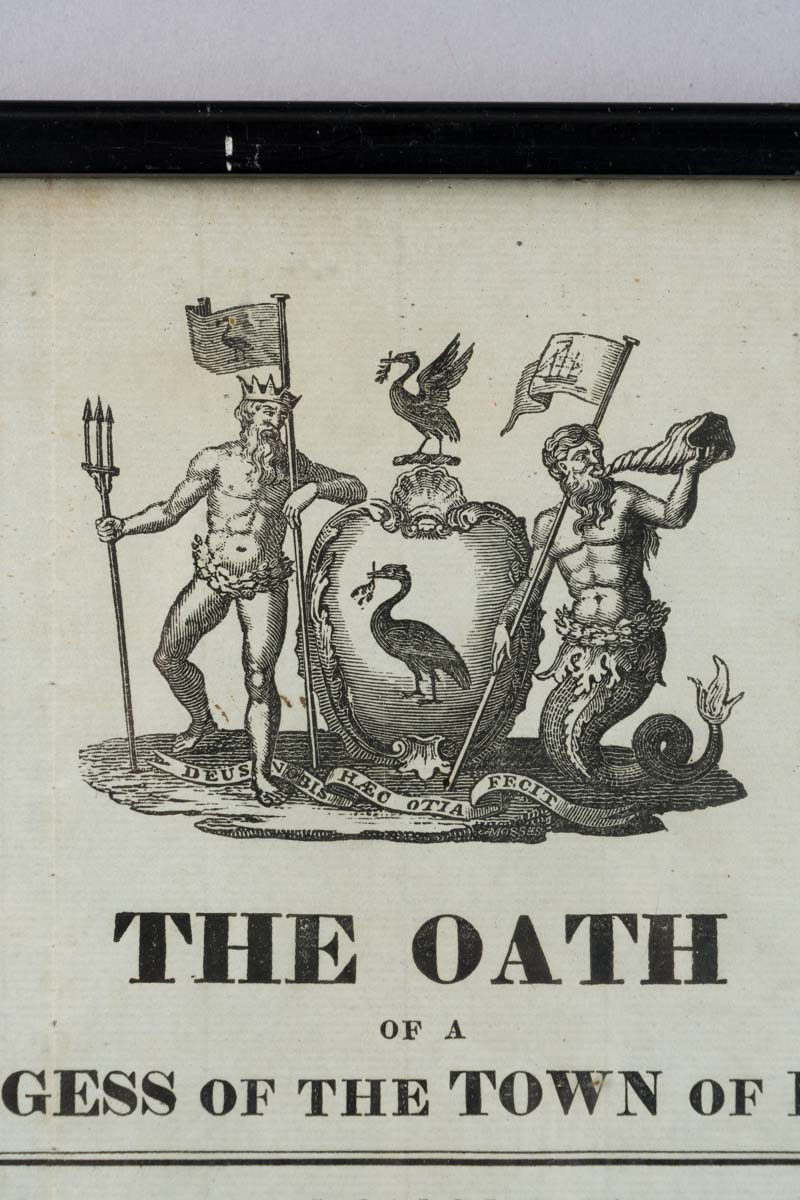
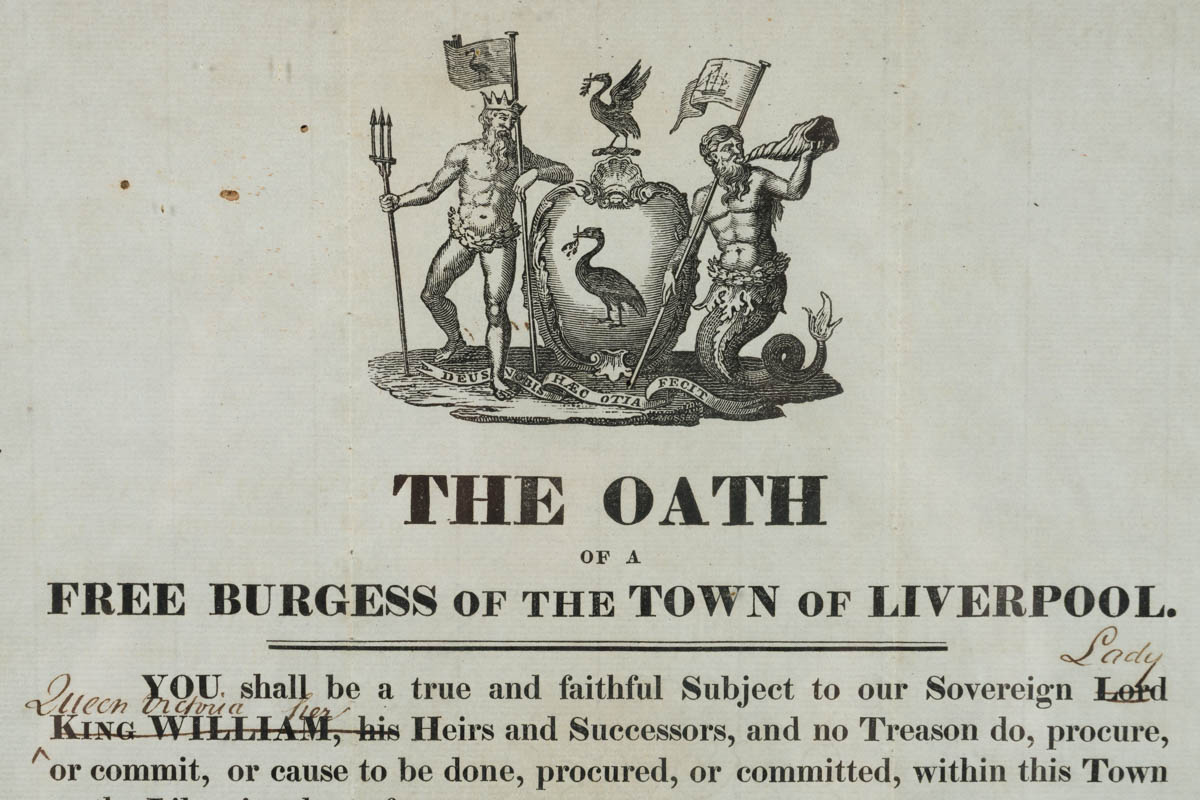
The document is headed “The Oath of a Free Burgess of the Town of Liverpool” beneath a large engraved representation of the historic Liverpool arms, with Neptune and Triton flanking the central shield and Liver bird.
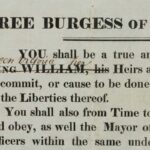
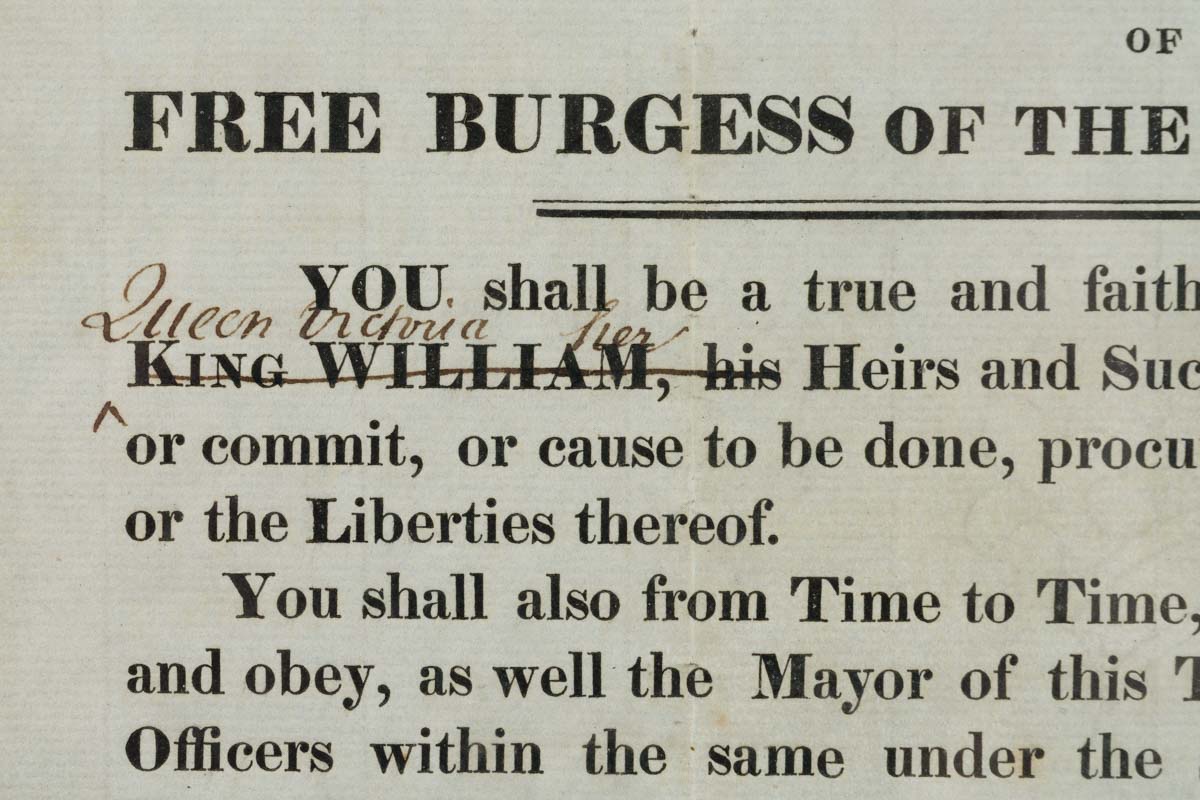
Of particular historical interest, the oath had evidently been printed during the reign of King William IV, whose name appears in the original typography. Following William’s death and the accession of his niece Queen Victoria on 20 June 1837, the obsolete royal references have been corrected by hand.
“King William” is struck through and “Queen Victoria” inserted in manuscript, while the masculine references to the sovereign are similarly amended. The document therefore preserves a fascinating administrative response to the change of monarch at the very beginning of the Victorian era.
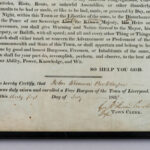
The certificate at the foot records the recipient as having been “duly sworn and enrolled a Free Burgess of the Town of Liverpool” on the thirty-first day of July 1837, only weeks after Victoria’s accession, and is signed on behalf of the Town Clerk.
The oath requires the burgess to remain faithful to the Crown, obey Liverpool’s mayor and officers, preserve the peace, protect the town’s liberties and customs, refrain from assisting outsiders to the detriment of Liverpool’s merchants and report riots, unlawful assemblies and disturbances.
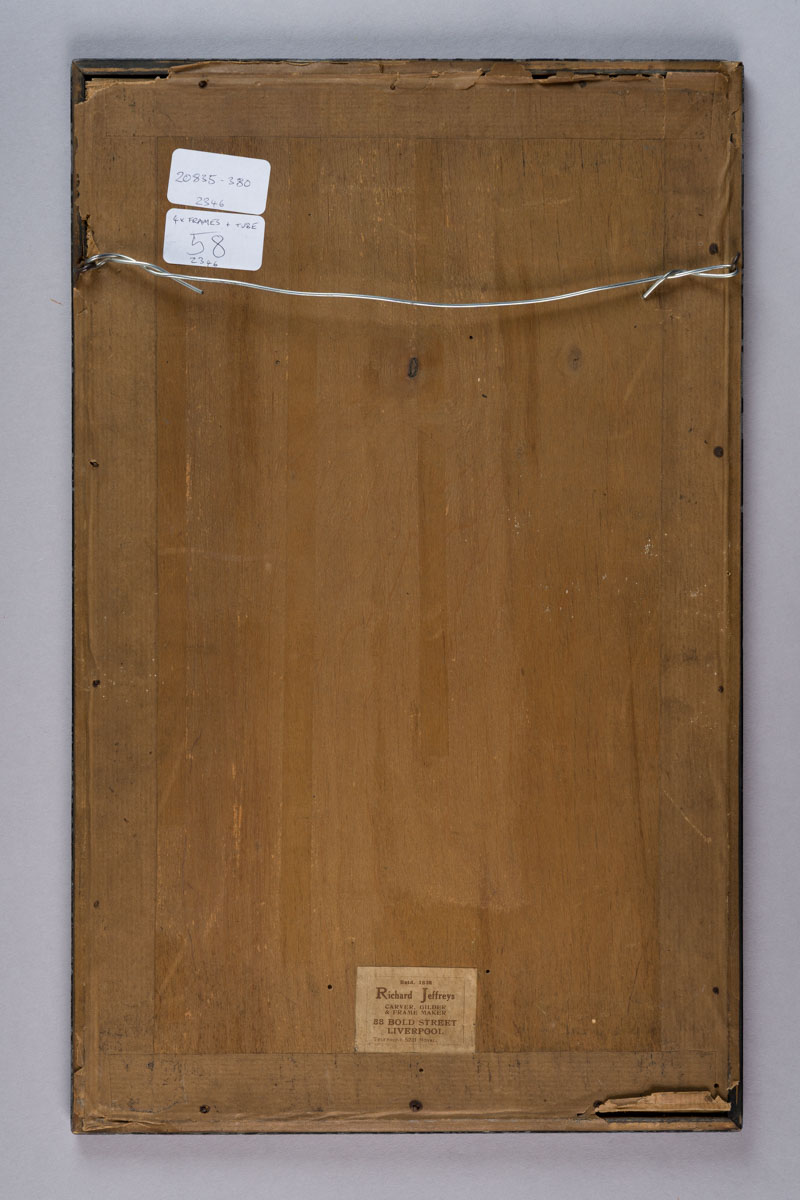
Printed on a large sheet with manuscript completion and contemporary alterations. Some age toning, spotting and marking, with old folds visible, but the printing and manuscript additions remain clearly legible. Preserved in an old black frame. The reverse retains the trade label of Richard Jeffreys, Carver, Gilder & Frame Maker, 88 Bold Street, Liverpool.
Title: The Oath of a Free Burgess of the Town of Liverpool
Recipient: John Rimmo [or Rimmon] Bookkeeper
Year: 1837
Edition: Original printed civic oath, completed and amended in manuscript
Authority: Corporation of Liverpool
Place: Liverpool
Format: Large printed broadside/document, manuscript additions, framed and glazed
1 in stock
On 20 June 1837, King William IV died at Windsor Castle.
His eighteen-year-old niece Alexandrina Victoria became Queen.
Across Britain, the machinery of government suddenly had to accommodate a new sovereign. Official documents, proclamations, legal formulae and oaths that had been printed in the name of William IV were immediately obsolete.
This Liverpool document captures that transition almost literally in ink.
The oath had been printed requiring its recipient to swear allegiance to “King William, his Heirs and Successors.” But when this particular burgess took his oath on 31 July 1837, Victoria had occupied the throne for only six weeks.
Rather than discard the existing printed form, somebody corrected it by hand.
“King William” was struck through. “Queen Victoria” was written above it. The masculine royal references were amended accordingly.
The result is a wonderfully tangible document from the opening weeks of what would become one of the longest and most consequential reigns in British history.
The document also belongs to another important story: the ancient institution of the freedom of Liverpool.
Becoming a Free Burgess was considerably more significant than receiving a ceremonial civic honour. Freemen historically enjoyed privileges associated with participation in the economic and civic life of the borough. The oath consequently demanded loyalty not only to the monarch but also to Liverpool itself — its mayor, laws, liberties, customs and commercial interests.
The wording is wonderfully evocative. The new burgess promises not to assist outsiders in ways that might harm the town’s merchants and undertakes to report “Riots, Routs, or unlawful Assemblies” threatening the peace.
More than a civic certificate, this is therefore a surviving fragment of Liverpool’s municipal government — made especially compelling by the handwritten transformation of a William IV document into a Victorian one.
The appeal of this document lies particularly in its precise historical date.
Dated 31 July 1837, it was executed only around six weeks after Queen Victoria’s accession, and the manuscript corrections provide direct physical evidence of that change of reign.
Rather than merely referring retrospectively to Victoria’s accession, the document shows an existing piece of government stationery being adapted because the monarch named upon it had just died.
It also has strong Liverpool interest. The prominent historic arms, substantial format, civic oath and original manuscript completion make it an attractive artefact for collectors of Liverpool history, British monarchy, municipal history and nineteenth-century manuscripts and documents.
The survival of the old Liverpool framer’s label on the reverse adds another appealing layer of local provenance.