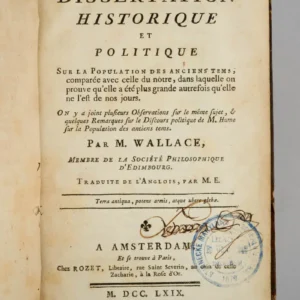
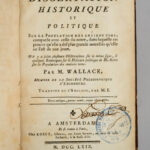
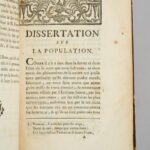
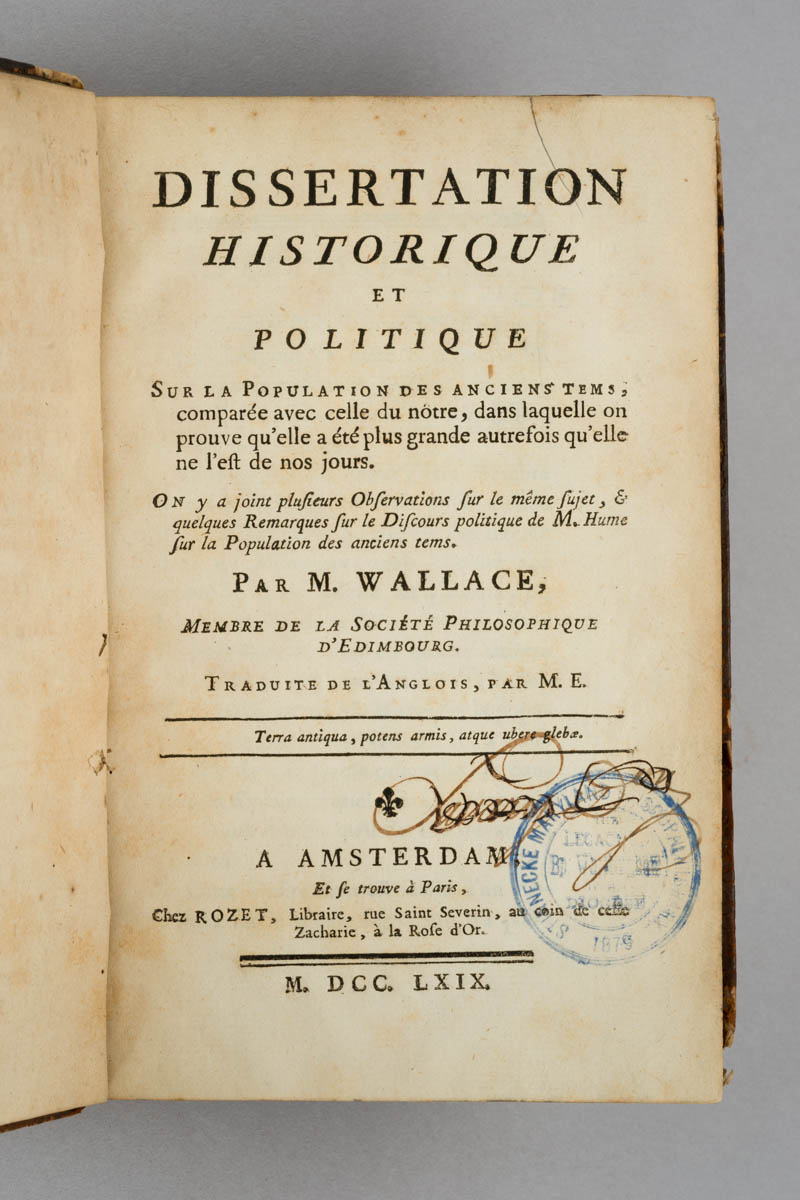
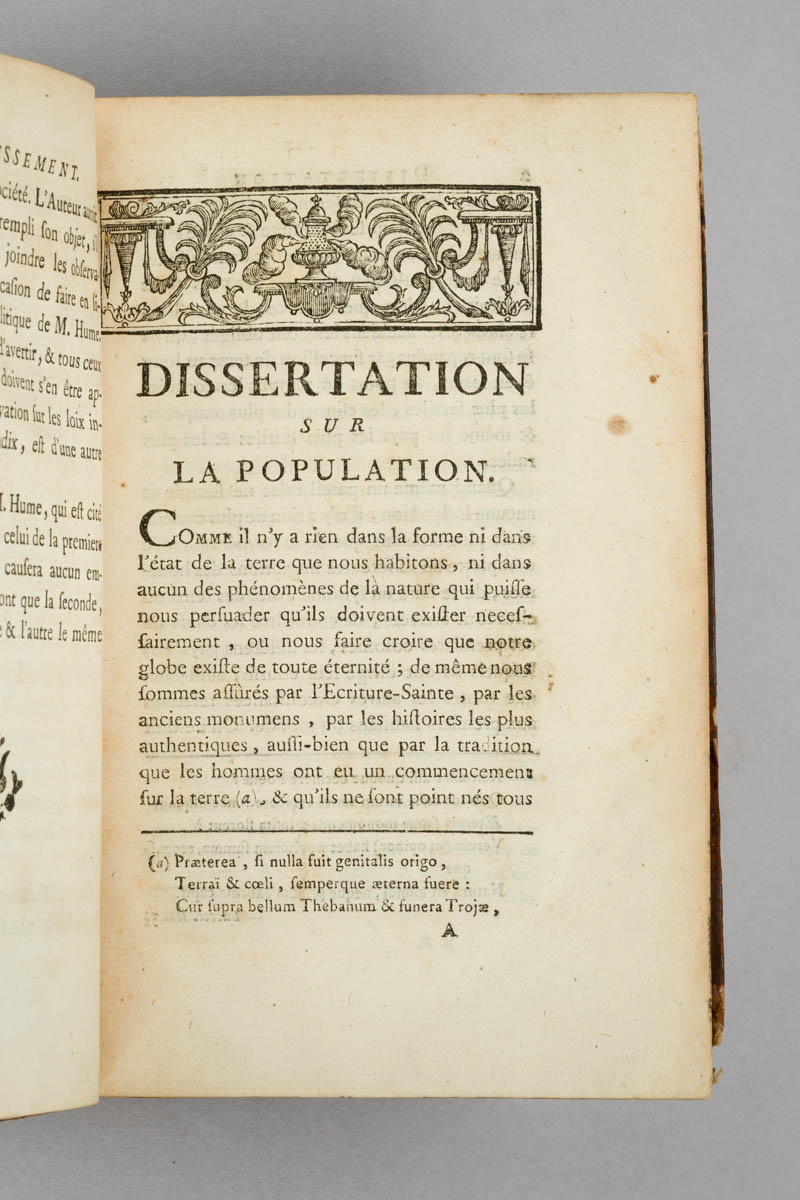
Published in French in 1769, Robert Wallace’s Dissertation Historique et Politique sur la Population des Anciens Tems belongs to one of the significant economic and demographic debates of the Scottish Enlightenment: were ancient societies more populous than modern ones?
Robert Wallace (1697–1771), a Scottish minister and member of Edinburgh’s Philosophical Society, argued that the ancient world had supported a substantially larger population. His ideas brought him directly into intellectual dialogue with David Hume, who took a different view.
The relationship between the two men makes this book particularly interesting. Wallace allowed Hume to read his work while it was still in manuscript, and Hume reciprocated by showing Wallace the essay that became Of the Populousness of Ancient Nations. Wallace’s original English Dissertation on the Numbers of Mankind subsequently appeared in Edinburgh in 1753 with an appendix responding to Hume. Oxford’s account of Hume’s Political Discourses confirms this exchange between the two thinkers.
The disagreement was conducted with unusual civility. Christie’s describes their exchange as becoming celebrated as a model of the Enlightenment pursuit of truth.
The present 1769 French edition, translated by Marc-Antoine Eidous, brought Wallace’s arguments to a wider Continental European readership. The title page explicitly advertises its remarks upon Hume’s political discourse. Bibliographical records confirm the edition as Amsterdam [Paris], Rozet, 1769, comprising iv, 380 pages.
This is therefore more than an eighteenth-century work on population: it is a surviving document from the intellectual conversation surrounding Hume, demography, political economy and the Scottish Enlightenment.
The principal attraction is the Hume connection.
This work arose from Wallace’s direct intellectual exchange with David Hume and includes Wallace’s observations on Hume’s Of the Populousness of Ancient Nations.
It also occupies an interesting position in the history of demography and political economy. Wallace was considering population growth, resources and the conditions affecting human population decades before Malthus’s famous Essay on the Principle of Population appeared in 1798.
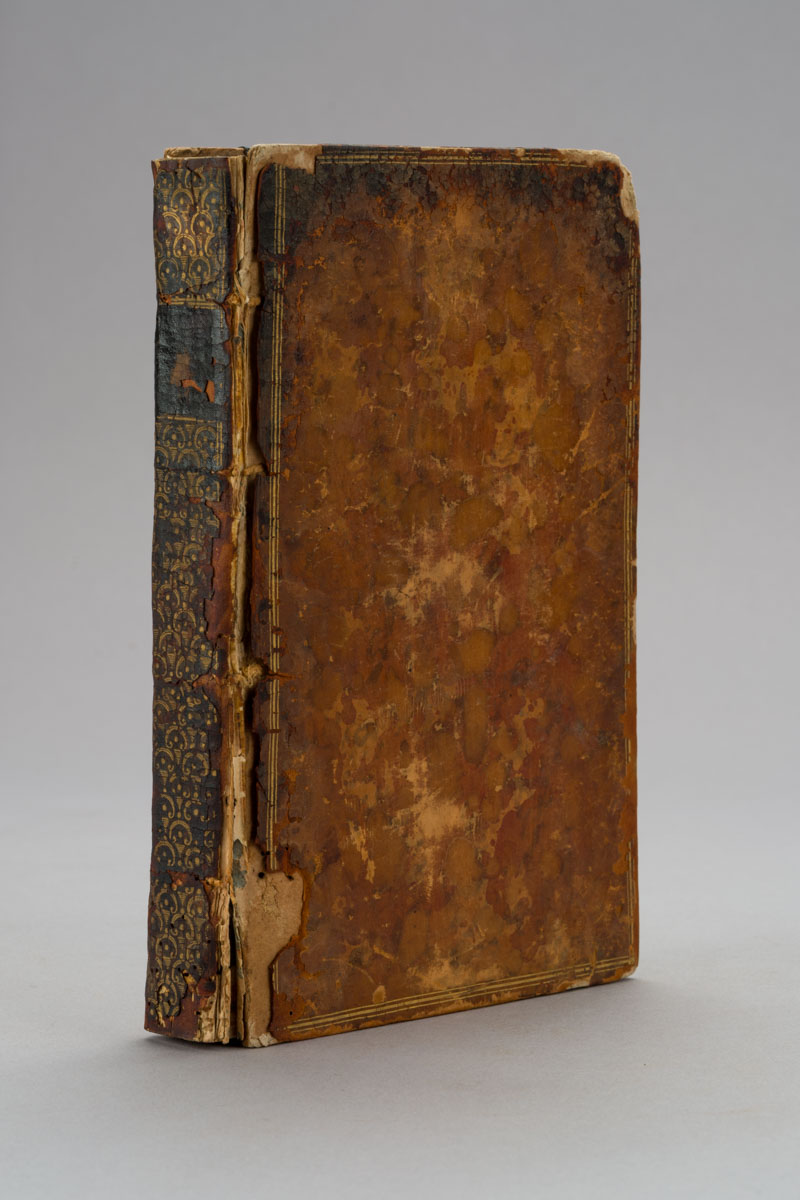
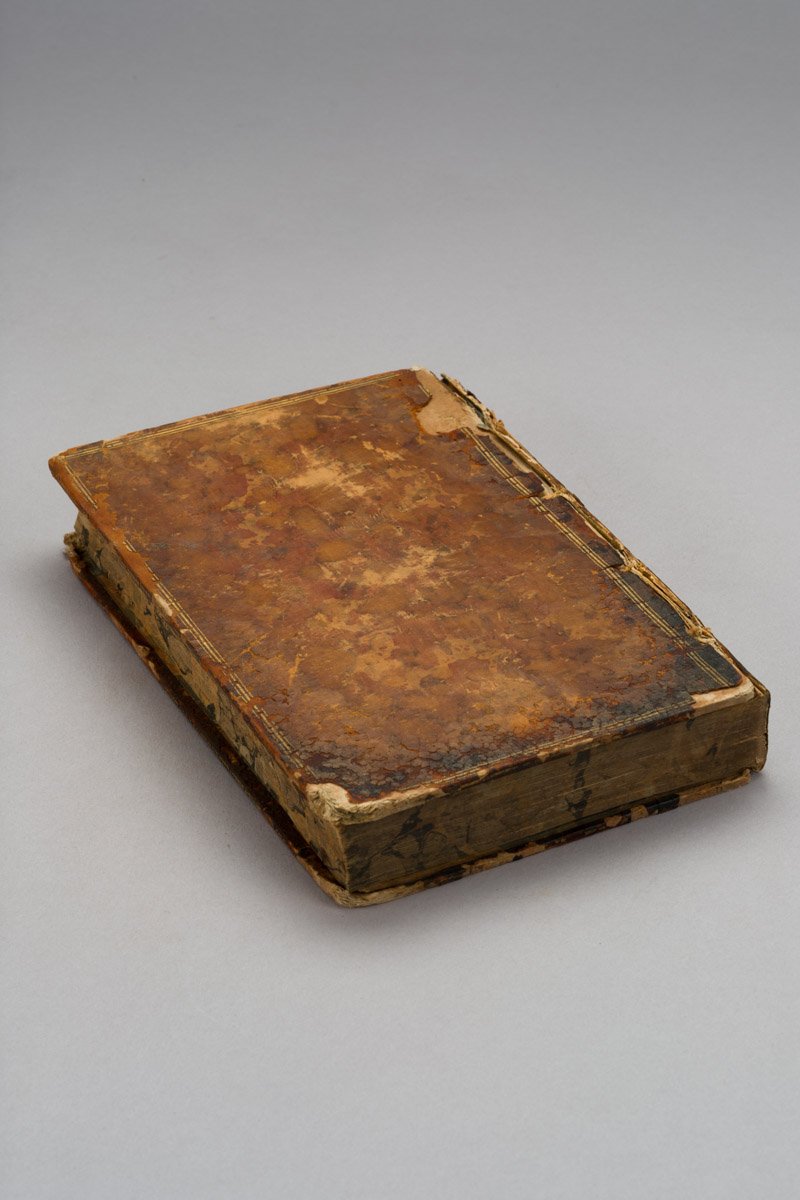
For collectors of David Hume, the Scottish Enlightenment, economics, demography, political philosophy or eighteenth-century intellectual history, it has considerably more significance than the physical condition might initially suggest.